Powerful, and complicated — and which of those two words dominates depends almost entirely on how many listings you run. At portfolio scale the automation is the value and the setup cost is worth paying once. With three or four properties, the same setup cost buys much less, which is exactly where the complaints come from. We compete with it, so treat this as an argued opinion rather than a neutral audit.
On this page
Where the value is realWhat hosts complain aboutWho should buy itRunning it alongside measured prices
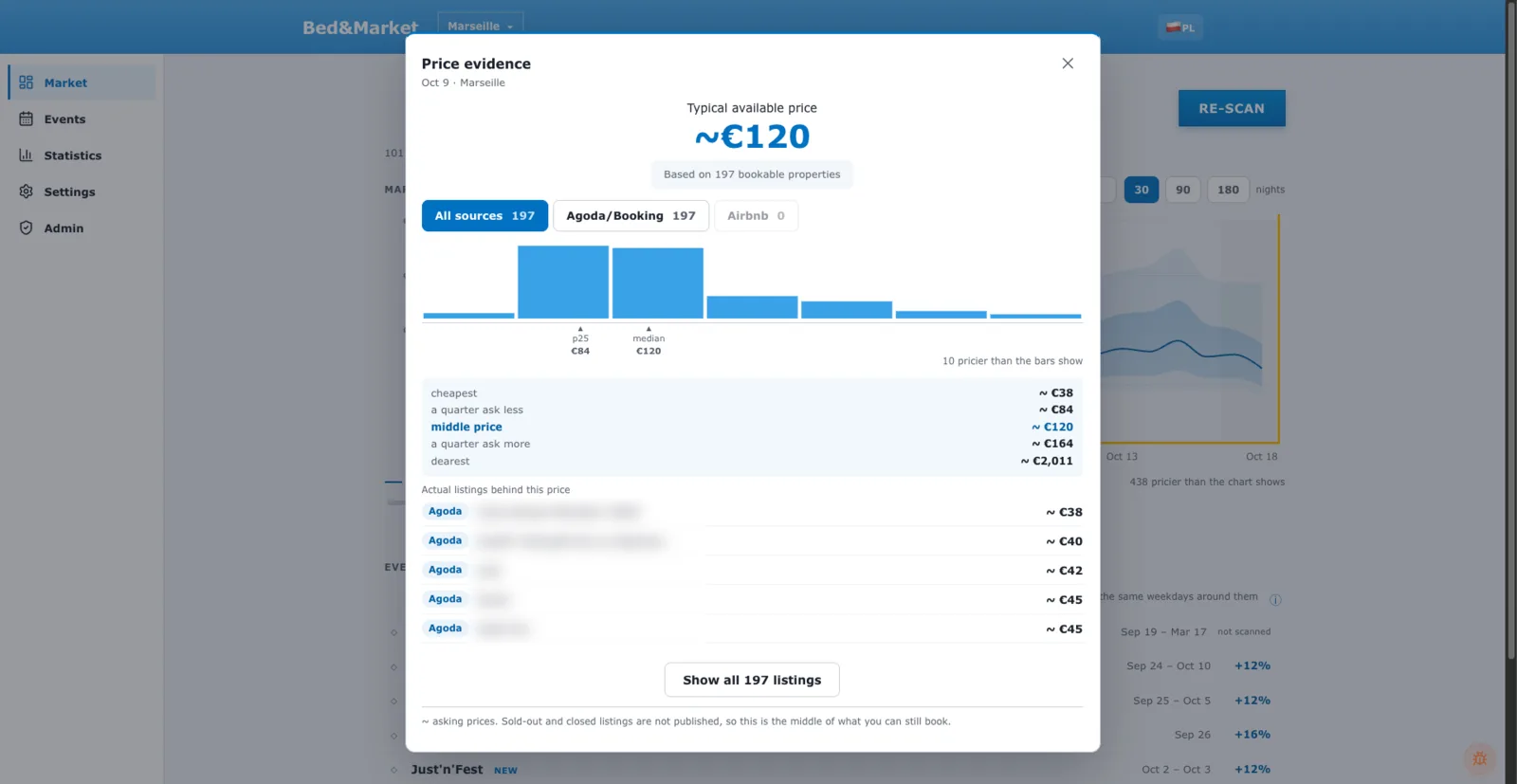
The difference this page is about, in one frame: a price you can open. 197 bookable properties for 9 October in Marseille, the middle one asking EUR 120, and the listings behind it. Listing names are blurred here; in the app they are not.
Where the value is real
A pricing tool answers one question: who sets tonight's price when you have too many listings to set it yourself. Four things it does that are hard to replace.
It takes the daily decision away
Connected to your account, it rewrites prices from demand models and your own booking history. Past a certain number of listings, nobody prices by hand well, and handing that over is the entire point.
Controls that a professional actually needs
Base price, floors, ceilings, day-of-week and length-of-stay adjustments, per-date overrides. The depth that makes it hard to learn is the same depth that makes it usable at portfolio scale.
It reacts while you are asleep
Last-minute discounting and far-out lifting happen on a schedule you do not have to keep. For a manager running dozens of units, that alone can justify the subscription.
It uses data only you have
Your booking history and pace feed its decisions. That is genuinely privileged information, and no outside-in tool — ours included — can see it.
What hosts complain about
Everything in this section comes from reading public host discussions. They are small threads and individual accounts, not measurements, and we are quoting them as what people said rather than as evidence of how the product performs on average.
Complexity is the recurring word
Reading host threads, the criticism that comes up again and again is not that it does too little but that it does too much. We saw three independent “too complex” complaints in the discussions we went through. These are small threads, not a survey, and we treat them as anecdotes.
Tuning is real work
One host reported roughly a 30% lift in income and, in the same breath, that he had tuned it weekly for a year before he trusted it. Both halves of that sentence matter, and the second half is the part that gets left out of most reviews.
Small portfolios feel the cost most
The complainant profile that recurs is a host with a handful of properties in a mid-size city who wanted something easier to use and possibly cheaper. At that scale the setup effort is spread over very few listings.
Suggested prices can read as wrong
One host we read described its nightly prices as very far from reality for his market. A model with the wrong floors set will confidently undercut you; that is a configuration problem, but it is one you have to notice before it costs you a season.
Two of those points pull in opposite directions on purpose. A reported 30% lift is a serious result and we are not going to pretend otherwise; a year of weekly tuning is a serious cost and most write-ups skip it. Both were said by the same person about the same product.
There is also a structural point worth separating from the complaints. Like every tool of its kind, it models demand it cannot observe — nobody outside the booking platforms sees what a guest actually paid. That is not dishonest, it is the only way to produce a suggested price. It does mean the output is an inference rather than something you can check against the world.
Who should buy it
“I run twenty units and cannot price them by hand”
Buy it
This is the job it was built for. Budget real tuning time up front and set your floors before you let it run unattended.
“I have three or four listings and a spare hour a week”
Maybe not
The setup and tuning cost is the same whether it is spreading over four listings or forty. This is where the complexity complaints come from.
“I want to see what my street is asking and decide myself”
Different tool
A pricing tool writes prices; that is the feature. If you want the decision to stay yours, you want measured comparables rather than automation.
Whatever you decide, set your floor before you switch automation on. A price floor is the one control that prevents a bad week of model output from becoming a bad month of bookings, and it is the setting hosts most often say they wish they had configured first.
Running it alongside measured prices
These are not mutually exclusive, and plenty of hosts run both. One sets the rate; the other tells you whether the rate the model chose matches what comparable places are actually asking for the same night. When a suggested price feels wrong, that comparison is the fastest way to find out whether it is.
Our side of that is deliberately narrow. We read asking prices from live listings on the big booking sites when you ask for a scan, night by night, with the events that move them. We never forecast, we do not claim booked rates, and nothing we run changes your listing — there is no write access at all, by design. First city scan free, no card.
If you are still deciding between categories rather than products, the head-to-head is Market-data tools vs pricing tools, and the market-research side has its own review.
Pricing tools and Bed&Market, side by side
We compete with a pricing tool on one row of this table and not on the rest, so read it as an argued comparison. The difference that matters is not which number is better — it is whether you can check the number at all.
Pricing tools vs Bed&Market · compared September 2026
Pricing tool
Bed&Market
Core job
Rewrites your prices daily
Shows what the town is actually asking
Where the number comes from
Demand models plus your own booking history
Asking prices read live from the big booking sites
Can you check it?
No — the model is the product
Yes — every price opens the listings behind it
Forecasts
Yes, projected demand
Never. Only what is asked now
Touches your listing
Yes — writes prices, by design
No write access at all
Setup
Hosts report weeks of tuning
One scan, nothing to configure
Best for
Portfolios too large to price by hand
Checking any suggested price against the street
What “measured” looks like on screen
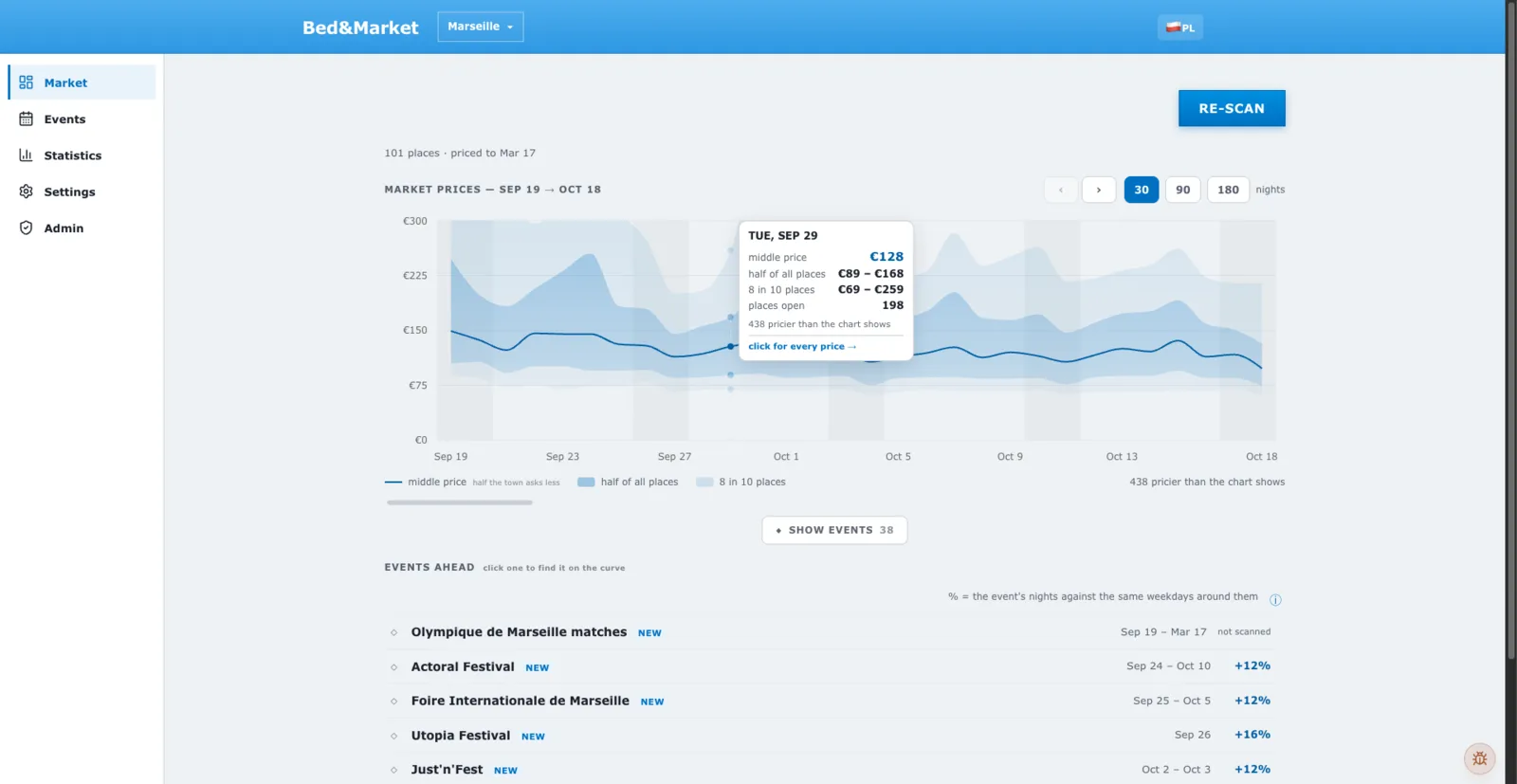
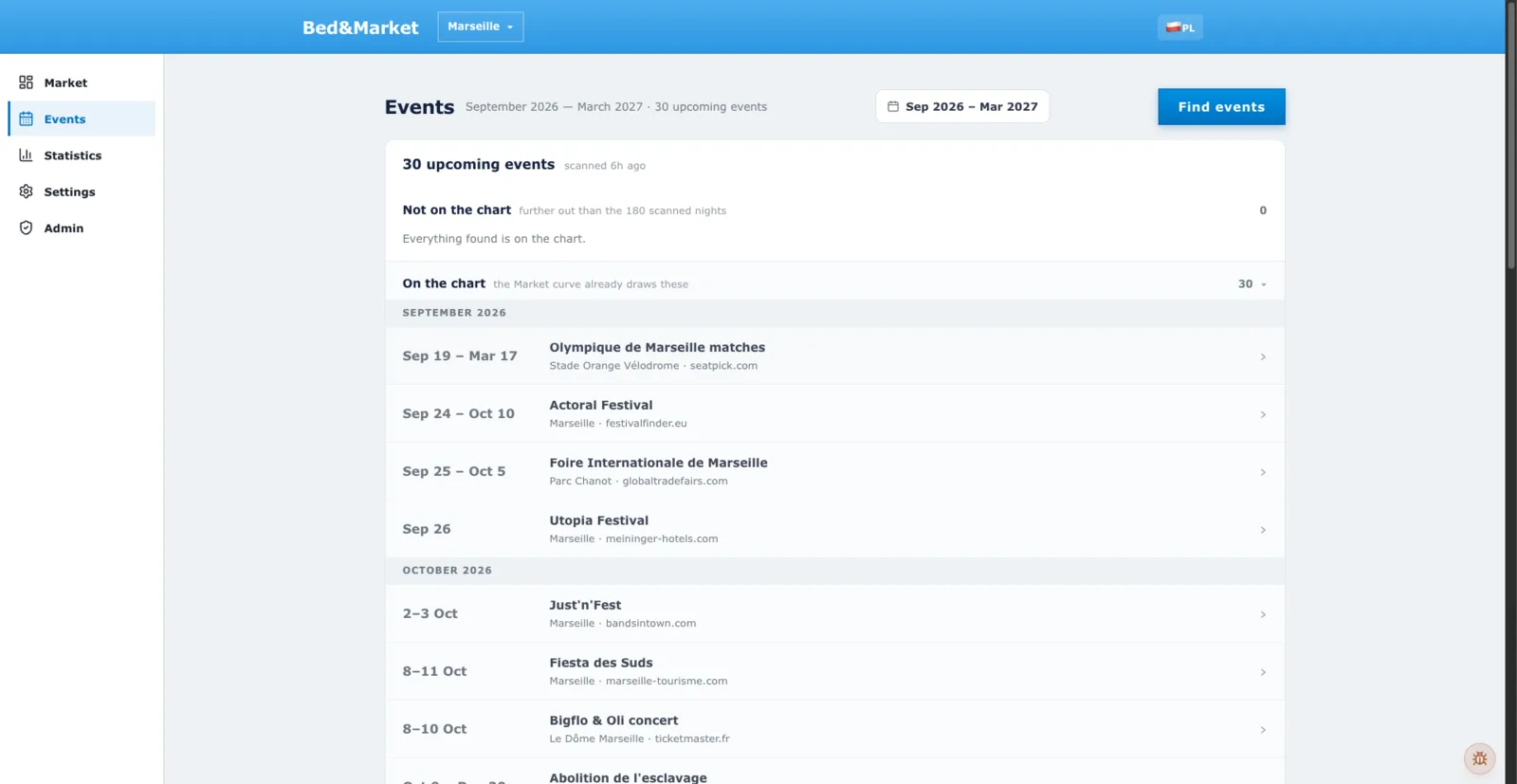
Screenshots from our own app, Marseille, September 2026. We are showing these because a claim about measurement should be checkable, and because the difference from a modelled suggestion is obvious the moment you see it.
Thirty nights of Marseille asking prices, read from live listings. The line is the median, the bands are the middle half and 8 in 10 — so a suggested price can be placed against the street on the exact night it applies to.The events under the curve, each with its venue and source, so a price spike has a named reason rather than a shrug.
Check a suggested price against the street
Three scans a week, free, no card. Live asking prices from the big booking sites, night by night. Measured, never forecast, never written to your listing.
 Bed&Market